Jeongdongjin & Okgye District
- Home
- Tour
- Nature Tour
- Jeongdongjin & Okgye District
-
-
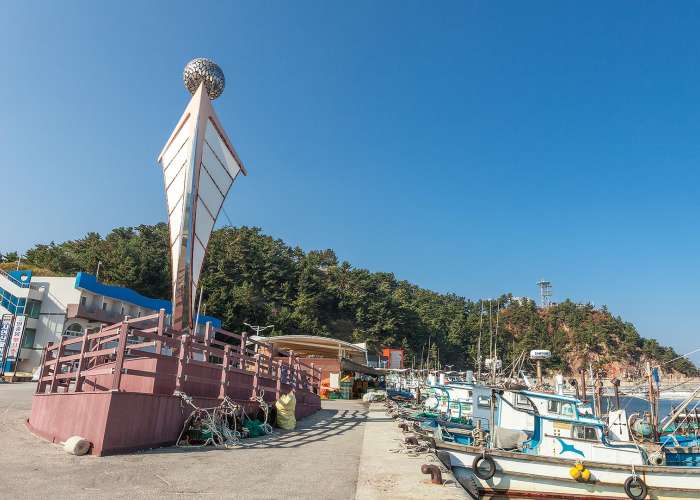
Anin Port
A quiet, small harbor perfect for travelers seeking tranquility
Introduction
Anin is located eastward when viewed from Chilsadang, the administrative office of Gangneung city during the Joseon Dynasty. The name “Anin” combines “An,” meaning comfort, and “In,” indicating the east direction, signifying a peaceful place to the east of Gangneung. Around 85 households in Anin are engaged in fishing, with approximately 42 fishing vessels. The main catch includes flounder and halibut, along with abalone and various seaweeds. Notably, halibut and abalone are actively farmed. The primary coastal fishing grounds lie within 1–5 km offshore. The main fishing season runs from October to February, primarily harvesting flounder and halibut. Where the Gunsun River meets the sea, mullets are abundant, attracting local fishing enthusiasts. Every year, a rich harvest festival is held on March 3 and September 9.
Tourist Guide
A little further down from Anin Port, you will reach Jeongdongjin. Here, visitors can purchase fresh seafood and enjoy nearby golf courses, offering a scenic view of the expansive sea while playing. There are also horseback riding centers and natural recreational forests nearby, providing memorable experiences for families with children.
Travel Tips
One may wonder, “Can such deep blue waters exist in Korea?” The sea at Anin Port is so clear that its depth seems immeasurable. Even during peak seasons in Gangneung, the harbor rarely accommodates more than 500 visitors, offering a tranquil experience for families or couples seeking quiet reflection. The beachside restrooms are exceptionally clean, and lodging is conveniently available right in front. Anin Port is renowned for sea fishing, including flounder and mullet fishing, making it a beloved spot for anglers. Visitors are highly encouraged to try sea fishing; the unique thrill of catching fish often draws people back to Anin Port. Freshly caught sashimi can be enjoyed at local restaurants at reasonable prices, or visitors can purchase seafood at nearby centers without fishing. The hospitable spirit of Gangwon-do is felt throughout. Anin Port also hosts a participant flounder experience center, recommended for those interested. The nearby Yeomjeon Beach offers gentle, serene waters and wide sandy beaches, perfect for relaxation. If traveling by car, visiting Jeongdongjin further down is also recommended. Gangneung has many harbors and beaches along its long coastline, each offering a distinct atmosphere, and Jeongdongjin has its unique charm. Fresh sashimi from the East Coast tastes very different from that of the West Coast. In autumn, crabs make a particularly delicious meal. For those who prefer cooked dishes, seafood kalguksu (noodle soup), Chodang soft tofu, and Gangneung-style jjambbong are highly recommended. Families with children can enjoy horseback riding and natural recreational forests, while adults may enjoy golf and leisurely hobbies.
-
-
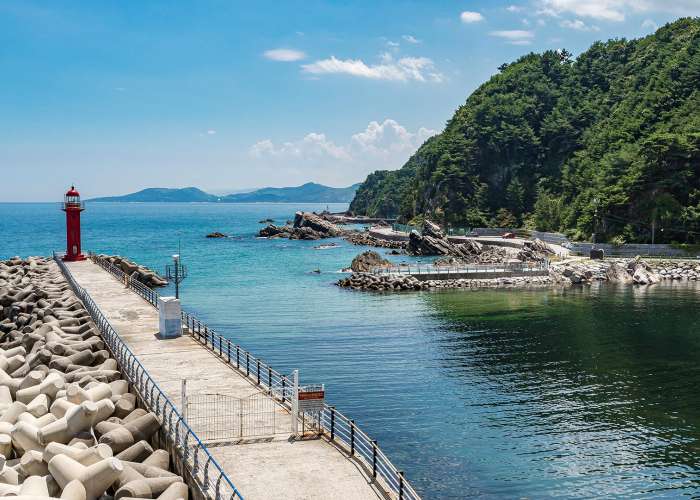
Simgok Port
A harbor with stunning coastal cliff scenery
Introduction
The village is called “Simgok,” meaning “deep valley,” as it is located within a deep valley. It was also once referred to as “Jipil (紙筆)” because the village appears flat like paper laid on the ground, with the shape of a brush placed beside it. However, the name was officially established as Simgok in 1916 following administrative district reorganization. As a remote village nestled between mountain ranges on both sides, it is said that during the Korean War, the residents were unaware that a war had even broken out. Today, with the rise in popularity of Jeongdongjin as a sunrise destination, Simgok Port has gained attention. Surrounded by both mountains and the sea, it boasts exceptionally beautiful scenery.
Tourist Guide
Most residents are engaged in fishing, with representative catches including flounder, abalone, and saury. The naturally harvested rock laver (seaweed) from this area is of outstanding quality and was historically presented to the king. The port is also famous for flounder fishing using fishing boats in the nearby waters. From the sea, the view of the coastal cliffs facing the harbor is remarkably beautiful. Recently, a coastal road has been constructed connecting Geumjin Port in Okgye-myeon, passing through this area, and extending to Jeongdongjin Port, making it an emerging tourist attraction.
Travel Tips
As you descend from Jeongdongjin Sculpture Park, you will encounter Simgok Port, which reveals a tranquil and secluded atmosphere befitting a harbor nestled deep in a valley. With rocky cliffs on both sides and the sea embraced by mountains, it is well known as a scenic driving course. It is an ideal place to relax your mind when feeling stressed or to enjoy a weekend drive with family. Although it may be easy to pass by, it is one of the three most beautiful ports in Gangwon State. The three most beautiful ports in Gangwon State include Simgok Port, Namae Port located about 6 km from Jumunjin, and Chogok Port in Samcheok. At Simgok Port, the deep blue waves of the East Sea crash against rocks scattered across the water, creating a refreshing and awe-inspiring view. It gives the sensation of driving over the sea. Driving along the road of Simgok Port, a favorite course for couples, makes you truly realize why it is said to be the closest road to the sea on the Korean Peninsula. As you navigate the winding coastal road, it feels as though you are driving directly over the ocean. While the sea here is beautiful in summer, it is even more stunning in winter. When snow covers the mountains beside the road and the sea glows in deep cobalt blue, the entire landscape becomes like a painting.Around Simgok Port, you can find restaurants serving spicy fish stew made with “mangchi” fish, a local specialty caught year-round regardless of season, making it a representative fish of the area. A spoonful of this spicy stew, combined with the dramatic rocky scenery and deep blue sea, creates an unforgettable experience. Taking a motorboat ride from Jeongdongjin offers another perspective of the coastal reefs and cliffs. As the boat passes between the rocks, it feels as though it might collide with them, creating a thrilling sensation. It is also a great spot for sea fishing, with people enjoying fishing from the breakwater or venturing out by boat to fish near offshore reefs. However, fishing should be avoided on days with strong waves or swells.On clear days, the deep blue sea is vivid and beautiful, but rainy days add even more charm and atmosphere. Visiting on a rainy day may make you feel like the main character in a movie. While the sunrise along the East Coast is beautiful everywhere, the sunrise viewed from Simgok Port is particularly stunning as it rises between mountains, rocky cliffs, and reefs.
-
-
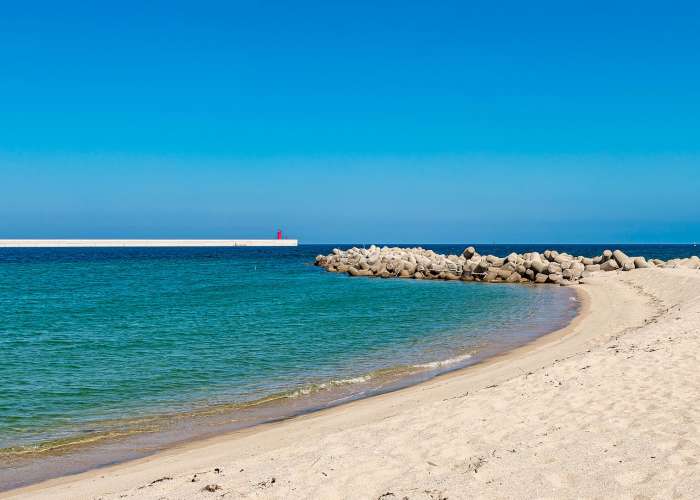
Yeomjeon Beach
A simple beach with a sandy shoreline
Introduction
Yeomjeon Beach is located in Anin-ri, Gangdong-myeon, Gangneung-si, Gangwon State. This small and quiet beach offers a relaxing retreat with emerald-colored waters. Although it is a modest-sized beach, it is equipped with convenient facilities such as showers, changing rooms, restrooms, and a campsite.
Tour Guide
Yeomjeon Beach is generally peaceful and relatively small, but it is rich in a variety of fish species, making it a popular destination for fishing enthusiasts. Visitors are encouraged to enjoy leisurely fishing throughout all four seasons, catching various types of fish. Despite its small size, the beach is well-equipped with facilities for tourists.
Travel Tips
Yeomjeon Beach is a simple beach featuring a wide sandy shore. Until the 1960s, salt fields were located beneath the Yeongdong Thermal Power Plant, and due to its proximity to Gunseon River, where seawater and freshwater meet, it has become a popular fishing spot for tourists. If you are looking for a quiet and serene natural setting to relax, Yeomjeon Beach is highly recommended.In spring, mullet migrate from the sea into freshwater, offering an exciting opportunity to catch large, arm-sized fish using casting nets. After the mullet season, schools of halfbeak begin to appear, attracting fishing enthusiasts. In winter, black porgy season provides another enjoyable fishing experience. In addition to seasonal catches, a wide variety of fish such as wrasse and flounder can be found throughout the year, with marine worms commonly used as bait.Besides fishing, tying leftover pork belly or meat heads to a line and catching small crabs hiding in rock crevices can create unique and memorable experiences. Around Yeomjeon Beach, you can also see numerous flounder fish farms.Between Jeongdongjin Station and Yeomjeon Beach, there is a scenic walking route with beautiful ocean views, perfect for a leisurely stroll and relaxation.In Gangneung, Jang Kalguksu (spicy noodle soup) is a local specialty. There are well-known restaurants near Yeomjeon Beach, so visitors are encouraged to enjoy a bowl after spending time at the beach. Additionally, many seafood restaurants nearby offer fresh raw fish, making it a great place to savor the flavors of the East Sea.
-
-
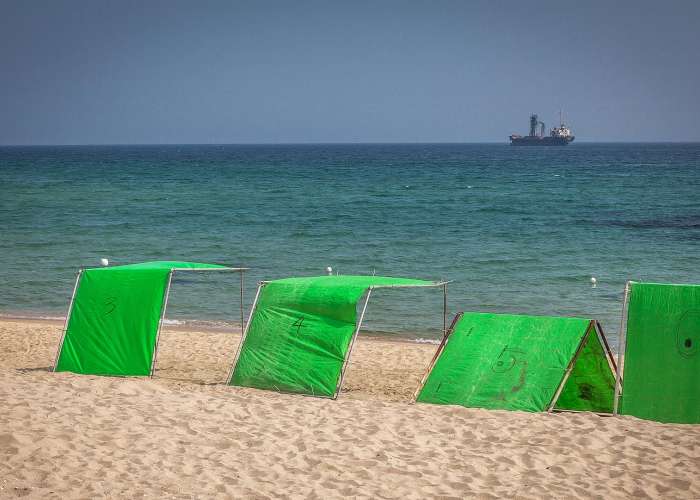
Dojik Beach
A 500-meter-long simple beach located at the southernmost end of Gangneung City
Introduction
Dojik Beach is a simple beach located in Dojik-ri, Okgye-myeon, at the southernmost part of Gangneung City. It stretches 500 meters in length and covers an area of 50,000㎡. The name “Dojik” comes from the word meaning “straight,” referring to the straight layout of the village. With the construction of the Donghae Expressway, the village was divided into two parts, and residents relocated as a group, leaving the original village no longer in existence. True to its name, this is a rare place where five transportation routes—national highway, railway, expressway, airway, and sea route—run parallel to each other.
Tour Guide
Dojik Beach is known for its clean sand and spacious parking area, making it a მშვიდ and popular destination for families. For accommodation, visitors can use local guesthouses. The beach features a simple parking lot of approximately 3,000㎡ and a campsite of about 1,000㎡ that can accommodate around 66 tents.Around Dojik Beach, fish such as wrasse, rockfish, and flounder are caught throughout the year. On weekends, it is common to see families enjoying fishing together, often using marine worms as bait. Four fishing boats operate year-round, harvesting octopus and clams. In spring, filefish and olive flounder are mainly caught, while in autumn, yellowtail and gizzard shad are the primary catch. Boats usually return to port around 2–3 PM.Seaweed (March–May), sea squirts (year-round), sea cucumbers (December–March), sea urchins (December–May), jinuwari seaweed (spring), hijiki (February–May), and laver (January–March) are also harvested, with returns to port around 1 PM.
Travel Tips
Located next to the well-known Mangsang Beach, Dojik Beach is the southernmost beach in Gangneung. Although not widely known, it is a place that quickly captures visitors’ hearts once experienced. Situated between Okgye Service Area and Donghae Service Area, the beach lies along the Yeongdong Line railway and the Donghae Expressway (Route 65), and can also be accessed via National Route 7 from Gangneung.As it is within a military zone, the beach is open only during the peak summer season. It offers a quiet and clean environment. To find accommodations, it is easier to cross the railway and expressway into Dojik-ri. The presence of barbed-wire fences creates a solemn atmosphere and can evoke a sense of the division of Korea.Recently, there have been efforts to build modern pensions, but there is a hope that accommodations reflecting the local character of Dojik-ri will be preserved rather than overly urbanized styles. Instead of uniform beaches, it is desirable to maintain the unique identity of each region.Although the sandy beach is not very wide, there is a campsite available. It includes shower facilities, and the ground is natural soil. Camping is available for approximately 10,000 KRW per night. This beach is ideal for campers seeking a quiet environment, but the campsite is not operated during winter due to freezing issues with water facilities.Like other beaches, Dojik Beach operates during July and August, and there is no entrance fee. While many visitors come to enjoy swimming, it is also popular among anglers targeting wrasse.After enjoying the beach, cross the road and explore Dojik-ri village. Although the original village disappeared due to the expressway, relocated residents have settled across the beach. The village still retains the appearance of a traditional fishing community, including a Seonangdang shrine located on the hillside near the expressway. This wooden shrine hosts annual rituals.While such rituals may seem like stories of the past to outsiders, for local residents whose livelihood depends on fishing, they represent earnest wishes for safety, prosperity, and abundant catches. Observing the shrine, one cannot help but hope that these local traditions will not disappear under commercial development.Nearby attractions include Neulhaetsal Rural Experience Village (Manwoo Village), Daejin Village, and Mukho Port. Other nearby camping sites include Donghae Mangsang Auto Camping Site, Okgye Beach, and Nobong Auto Campground.
-
-
Jeong Dong Jin, Okgye
 열린관광지
열린관광지
Hourglass Park
A charming park set against the backdrop of the East Sea and mountains
Introduction
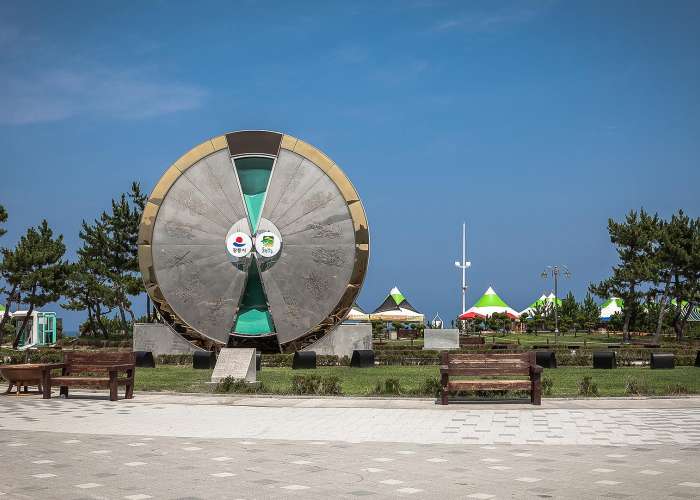
Jeongdongjin Hourglass Park was created in 1999 by Gangneung City and Samsung Electronics to commemorate the new millennium, with a total project cost of 1.28 billion KRW. The hourglass inside the park is the largest in the world, measuring 8.06 meters in diameter, 3.20 meters in width, weighing 40 tons, and containing 8 tons of sand. It takes exactly one year for all the sand inside the hourglass to fall from top to bottom.
Tourist Guide
Hourglass Park was established to commemorate both the popular drama “Sandglass” and the new millennium, and features the Jeongdongjin Millennium Hourglass. Nearby attractions include Jeongdongjin Sculpture Park, Jeongdongjin Station, and Jeongdongjin Beach. There are no admission or parking fees.
Travel Tips
Hourglass Park is modestly designed with the East Sea, surrounding mountains, and Jeongdongjin 2-ri village as its backdrop. At the center stands the hourglass, surrounded by pine trees, while benches are placed facing the sea. Unlike sundials or water clocks that indicate the current time, an hourglass measures the passage of time based on the volume of sand falling due to gravity. Historically, hourglasses were made in various durations such as 4 hours, 2 hours, 1 hour, and 30 minutes, as well as 28 seconds and 14 seconds for measuring ship speed. These were widely used until the 19th century, and today, a 3-minute hourglass is commonly used for boiling eggs. It is said that the hourglass was invented around the 8th century by a French clergyman named Liutprand.The Jeongdongjin Hourglass differs from the typical narrow-waisted glass shape, as it is designed in a round form to symbolize the infinity of time. The circular shape also represents the rising sun over the East Sea, while the 32-meter-long parallel train rails symbolize the eternal flow of time. The falling and accumulating sand signifies the continuity of time rather than a separation between the past and the future.Jeongdongjin, where the hourglass stands, is located directly east of the milestone marker in front of Gwanghwamun in Seoul. It is known as one of the first places on the Korean Peninsula to see the sunrise during the summer solstice, attracting many visitors. It is highly recommended to visit with family to enjoy the beautiful sunrise and explore Hourglass Park.